Home-Based Childcare is Finally on the Global Agenda
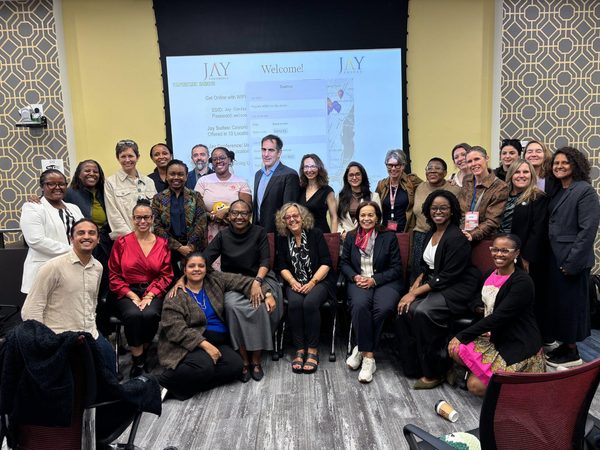
Global HBCC Alliance flagship event, New York, September 2026. The Alliance’s full Steering Committee, partner organisations, and a packed room of funders, policymakers, and civil society organisations.
NurtureFirst’s observations at UNGA 2026, and what comes next By Gacheri Njogu-Ndongwe, Leah Justina Anyanwu, and Cindy Lithimbi | October 2026
For years, home-based childcare has existed in a stark paradox: present in millions of homes yet nearly invisible in global policy forums.
In New York this September, NurtureFirst joined partners, policymakers, funders, and providers for a week that marked a meaningful shift. The question along the corridors shifted from “what is home-based childcare?” to: “who are you working with, what does the evidence say, and what are you prepared to commit to?” That change, from explanation to accountability, is what progress looks like.
This piece reflects what the NurtureFirst team observed at UNGA 2026 — primarily through the Global HBCC Alliance’s debut as a formally coordinated body, and the evidence and government engagement that surrounded it.
Above all, the week reinforced that centre-based and home-based childcare must coexist and are critical to achieving universal quality childcare. Families depend on both models, governments must invest in both, and any policy approach that differentiates between them will ultimately let down children in every setting. Home-based childcare is not peripheral or second-tier, and caters to most of the world’s youngest children. What UNGA 81 showed is that there is now enough global interest, programming, and political will to stop having that argument and to start building the enabling environment that children need.
Putting Home-Based Childcare on the Global Agenda
On 25 September 2026, the Global HBCC Alliance held its flagship event in New York — its first public convening as a formally constituted body since the launch in Kigali, Rwanda in May 2026. The event drew 91 participants including funders, government officials, researchers, providers, and civil society representatives from across the globe.
The Alliance’s Steering Committee was present for the first time on a public stage, representing OneSky (Vietnam), BRAC IED (Bangladesh), tiney (United Kingdom), NAFCC (United States), SmartStart (South Africa), and aeioTU (Colombia). They were joined by new partner organisations, including Kidogo and HomeGrown, alongside a broad audience of sector leaders. audience.
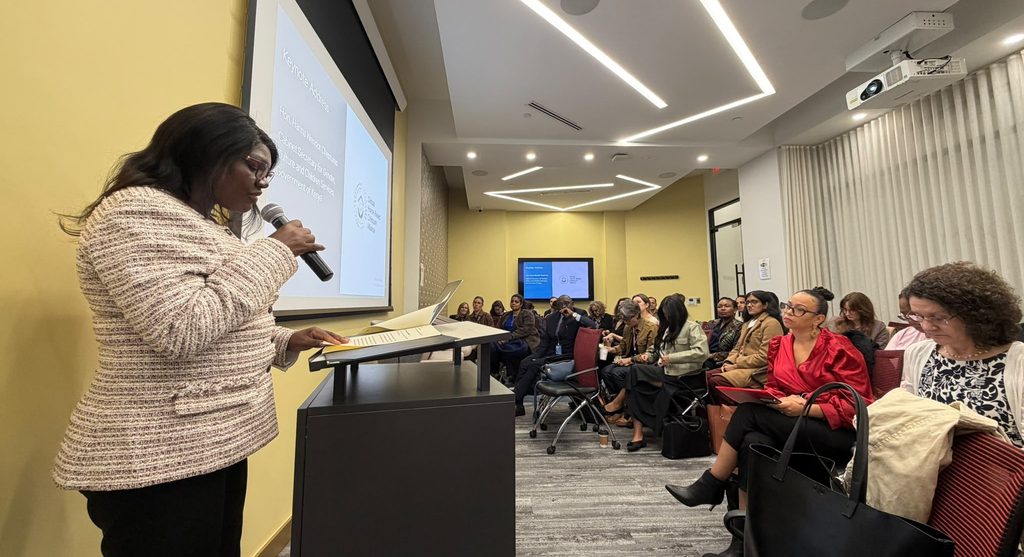
CPA Carren Agengo, Principal Secretary at the State Department for Children Services, Kenya, delivered the keynote. That Kenya’s PS — the official most directly responsible for shaping national HBCC policy — chose to open the Alliance’s global debut was a promising signal that this administration is committed to childcare.
CPA Carren Ageng’o, Principal Secretary, State Department for Children Services, delivers the keynote address on behalf of Cabinet Secretary Hon. Hanna Wendot Cheptumo at the Global HBCC Alliance flagship event, New York, 24 September 2026.
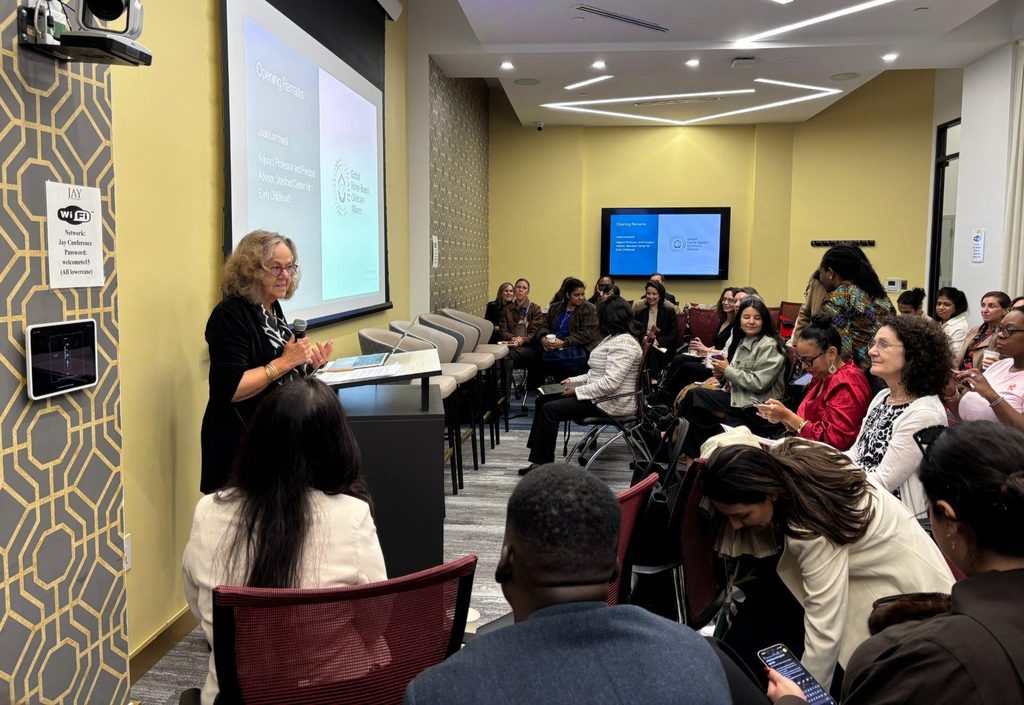
Dr. Joan Lombardi, Adjunct Professor and Principal Advisor at the Stanford Center for Early Childhood, opened the session by highlighting that home-based childcare is not a gap filler but a form of care in its own right, with its own strengths, evidence base, and policy case.
Dr. Joan Lombardi, Adjunct Professor and Principal Advisor, Stanford Center for Early Childhood, gave opening remarks and set the stage for a global dialogue on home-based childcare during the Alliance flagship event on 25 September 2026.
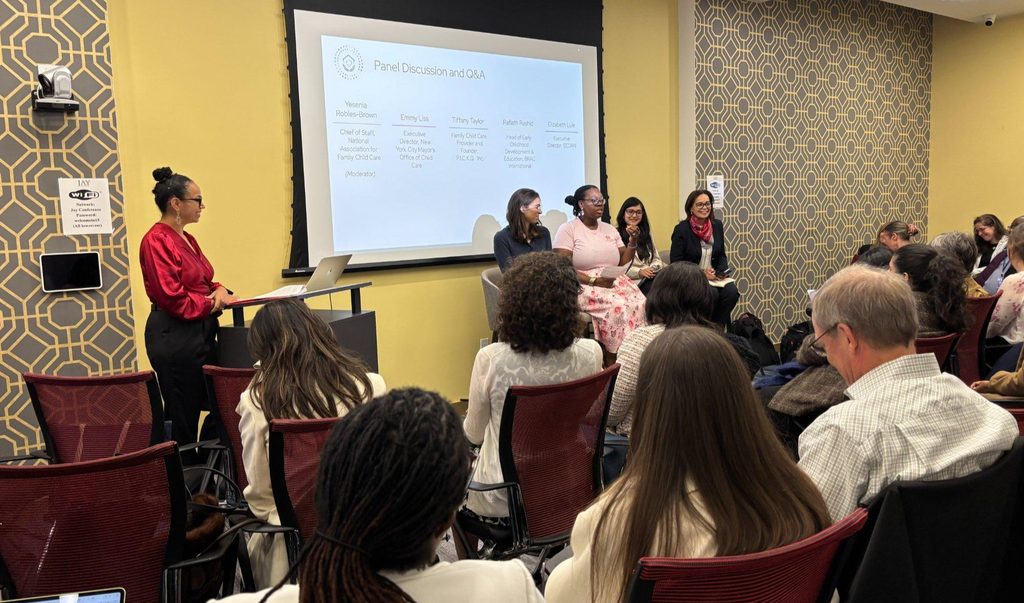
The panel, moderated by Yesenia Robles-Brown, Chief of Staff at NAFCC, brought together Emmy Liss, Executive Director of the New York City Mayor’s Office of Child Care; Tiffany Taylor, Family Child Care Provider and Founder of P.I.C.K.Q. Inc.; Rafiath Rashid, PhD, Head of Early Childhood Development and Education at BRAC International; and Elizabeth Lule, Executive Director of the Early Childhood Development Action Network (ECDAN).
Panel Discussion at the Alliance flagship event. Left to right: Yesenia Robles-Brown (moderator), Emmy Liss, Tiffany Taylor, Rafiath Rashid, PhD, Elizabeth Lule.
Tiffany Taylor’s account of her work in New York was among the moments that resonated the most across the week. Over and above typical childcare, she described counselling families when they arrive at her door, building a setting where children of different ages learn alongside each other, and receiving older children after school alongside their younger siblings — extending the reach of care well beyond what a standard job description would suggest. These are the dimensions of home-based childcare that rarely appear in policy documents, but are precisely why families choose it – cultural assets that are often not measured when comparing types of childcare.
What Tiffany described is not unique to New York. Home-based providers in Kenya share a similar story of a relationship with families that extends far beyond supervised play, of settings where children at different developmental stages learn from each other, and of care woven into community life. The similarities across very different contexts are striking. They are also the strongest argument for a global Alliance: that what is happening in Brooklyn and what is happening in Nairobi are versions of the same story, and that providers in both cities deserve to be seen, supported, and financed.
Emmy Liss brought the municipal government perspective. Mayor Mamdani aims to build a free, universal early care and education system for children up to 5 years and has moved to deliver free childcare to more than 10,000 low income families. New York City is actively investing in supportive policies for family childcare — formalising providers, connecting them to training and financing — which has triggered a more stable workforce, higher quality settings, and greater access for families. What the city of New York is making clear is that center-based infrastructure alone cannot bridge the global childcare gap. Universal coverage is only achievable when governments formally integrate and fund home-based care as an equal pillar of the system. When New Mexico rolled out universal childcare, it had to rapidly license over a thousand existing home-based providers because there was not enough centre-based capacity to meet demand. Home-based care is not a stopgap until enough centres are built. It is a central part of the infrastructure.
The enthusiasm in the room after the flagship event was telling. Funders, policymakers, and civil society organisations stepped forward to ask how they could get involved. The global appetite for home-based childcare solutions is growing — and the Alliance is positioned to organise that energy into action.
The Evidence Is Measurable
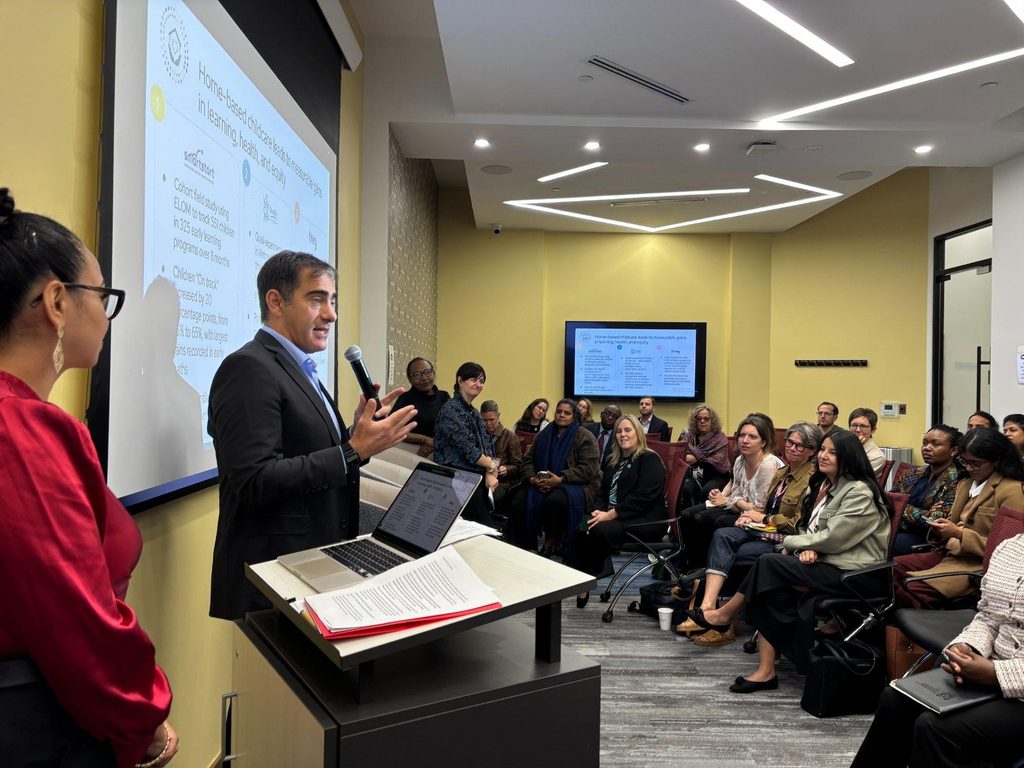
Evidence presentation at the Alliance flagship event. Cross-country data from Alliance Steering Committee members was presented showing measurable gains in learning, health, and equity.
The evidence presented, which focused on debunking common myths about home-based childcare, set out to challenge the assumption that home-based childcare is informal, unregulated, and low-quality. The data shared by Alliance Steering Committee members made that assumption difficult to sustain.
A word on the evidence debate. Some researchers and policymakers continue to call for randomised controlled trials and cost-effectiveness analyses as preconditions for public investment in HBCC. This is an important methodological question, and one the Alliance intends to address, but context also matters.
Many of the foundational studies on which centre-based care policy was built were conducted in high-income countries, under conditions that do not reflect the contexts where home-based childcare is most prevalent. To dismiss a care model used in millions of homes and that caters for the majority of the world’s youngest children because it lacks a particular type of study would be both disproportionate and, in practice, continue to marginalize care that currently serves these young children. The evidence below is equally compelling, and it is just the beginning.
Some sceptics say quality in home-based settings can’t be systematically improved. aeioTU and OneSky prove otherwise.
aeioTU assessed two cohorts of providers before and after their professionalization pathway. Knowledge scores increased by 5.2 percentage points in the first cohort and 9.6 in the second. Among 188 providers observed, the share of settings with learning materials within children’s reach rose from 69.3% to 84.3%. In Vietnam, OneSky’s quasi-experimental study of 418 providers found that trained providers scored 1 standard deviation higher than the control group on care quality in the short term, and 0.9 standard deviations higher in the medium term — gains that were sustained over time. National guidance for providers was co-created with the government.
Some sceptics doubt that home-based care promotes holistic child development. SmartStart, OneSky, and tiney prove measurable gains in learning, health, and equity.
SmartStart’s cohort field study tracked 551 children across 325 early learning programmes over eight months. Children “on track” for development rose from 45% to 65% — a 20 percentage point gain. Equally significant: the income-quintile gap in child outcomes narrowed from 25 percentage points to just 6, demonstrating that home-based care can actively close equity gaps. In Vietnam, OneSky’s study of 1,689 children found that provider training contributed a 0.2 standard deviation improvement in early learning composite scores. In the United Kingdom, tiney’s data across 4,165 children in 869 settings found approximately 60% fewer sick days than the nursery benchmark, and four to five times fewer illness episodes.
Sceptics say home-based care can’t provide providers with a sustainable livelihood. SmartStart, NAFCC, and tiney shows it can.
SmartStart tracked 90 franchisees at baseline and 80 of the same providers at 12-month follow-up. The share earning above R5,000 per month rose from 19% to 54%, while the share earning below R2,000 fell from 39% to 13%. Formal credit access in two districts nearly doubled, from 21% to 44%. In the United States, NAFCC’s EmpowerHer programme graduates saw a $10,000 increase in earnings, and 77% of family childcare educators with professional support can cover basic housing and utility costs, compared to 65% of those without it. In the United Kingdom, tiney childminders earn around £40,000 a year on average — compared to roughly £25,000 for full-time nursery staff.
These results are not pilot results from ideal conditions. They are outcomes from home-based settings across cultural contexts, in different income settings, under different policy frameworks. Seeing these cross-country datasets side-by-side for the first time delivered a collective impact far greater than any single country story could carry alone. These datasets are only a snapshot of what is happening globally. That is the Alliance’s mandate: to build the evidence base the HBCC sector needs, establish global best practices, and ensure that the next generation of data is as rigorous as it is representative.
Five Opportunities We Are Taking Into the Next Chapter
UNGA 81 did not resolve the field’s open questions. It sharpened them. Drawing from our conversations across the week, NurtureFirst is taking forward five critical opportunities to build the evidence, governance, and investment the sector needs:
1. Strengthen the economic case for HBCC investment.
The data presented at UNGA is a starting point. The opportunity is to build a rigorous, global evidence base that makes the cost-benefit argument for home-based childcare investment clear and compelling — for ministries of finance, for development banks, and for the donors who shape national budget priorities. The sector has evidence. It now needs the economic infrastructure to actualize it. The Alliance’s first collective task is churning evidence from OneSky, BRAC IED, tiney, NAFCC, SmartStart, aeioTU, Kidogo, HomeGrown, and other operators into a shared research hub.
2. Affirm — consistently and loudly — that home-based and centre-based care are complementary, not competing.
Universal childcare cannot be achieved through centres alone. When New Mexico launched universal childcare, the state quickly faced a hard reality: center-based capacity fell far short of demand, making the rapid licensing of thousands of home-based providers essential to achieving universal coverage. To achieve universal childcare at scale, both models must be funded, regulated, and supported. Any policy framework that pits them against each other will fail children in both settings. A core priority for the Alliance is advancing a unified vision—ensuring policymakers recognize mixed delivery as a strength rather than a compromise..
3. Build on government commitment and make it transferable.
During UNGA week, senior Kenyan leaders—most notably the Cabinet Secretary overseeing child welfare alongside the Principal Secretary for the State Department for Children Services—advanced tangible policy pledges. These included introducing a five-point national strategy focused on childcare and commissioning the national statistics bureau to gather population-wide childcare metrics. Emmy Liss’s account of New York City’s approach — formalising providers, connecting them to training and financing — shows what delivery looks like when a government decides to act. The opportunity is to document these models in sufficient detail that other governments can adapt them. Good policy travels when it is well documented and clearly executed.
4. Scale advocacy through coordination.
One home-based provider caring for ten children cannot change national policy alone. The Alliance represents providers, organisations, and governments from Brooklyn to Bogota — and its Steering Committee demonstrated that coordinated presence produces a more robust conversation than individual organisations working in parallel. As one Steering Committee member put it: how powerful would it be if home-based care providers in the UK could speak directly with providers in the US to share strategies and challenges? That collective voice is the lever. Building and maintaining it — with disciplined coordination and shared messaging — is another central task for the Alliance in the year ahead.
5. Build toward innovative financing — and the July 2027 milestone.
With the Global Early Years Financing Summit scheduled for July 2027, the Alliance has a clear near-term milestone: to arrive at that summit with a shared position on what financing home-based childcare at scale looks like. Models like tiney demonstrate that when childcare is treated as a credible sector worthy of investment — not a charitable cause — the results follow. Mechanisms like Kenya’ssocial protection frameworks are already being piloted at the county level and show what government-led financing can look like in practice.
Members of the Global HBCC Alliance Steering Committee and partners at UNGA 2026, New York.
Elevating home-based childcare to the global stage was a milestone. The real work happens now.
At the centre of all of this — behind the policy commitments, the evidence panels, and the Alliance conversations in New York — are children. The youngest children in home-based settings around the world cannot afford to wait for the sector to arrive at consensus. They are being cared for right now. They are playing, learning, growing… or they are not, depending on whether the provider looking after them has been trained, registered, and fairly paid. That is why the urgency is real and why the momentum from UNGA 81 must be carried forward.
About NurtureFirst NurtureFirst is a systems catalyst for home-based childcare, building an enabling environment where HBCC is visible, supported and sustainable. The Global HBCC Alliance was co-founded in May 2026 in Kigali, Rwanda, by NurtureFirst and six founding partner organisations — OneSky (Vietnam), BRAC IED (Bangladesh), tiney (United Kingdom), NAFCC (United States), SmartStart (South Africa), and aeioTU (Colombia). NurtureFirst serves as Secretariat. | www.hbccalliance.org